TEXT II
Brazil's mega hydro plan foreshadows China's growing
impact on the Amazon
by Jonathan Watts
Thu 5 Oct ‘17 06.45 BST
Last modified on Mon 27 Nov ‘17 15.56 GMT
The government wants to open up the Tapajós basin – an area the size of France – for trade
with China. But the indigenous Munduruku won’t let it happen without a fight
Crashing upstream through the São Luiz rapids, the churning river throws the
speedboat around like a child’s toy. There is first a moment of fear, then relief and finally wonder at
crossing a natural boundary that has held back the destruction of this corner of the Amazon for almost
five centuries.
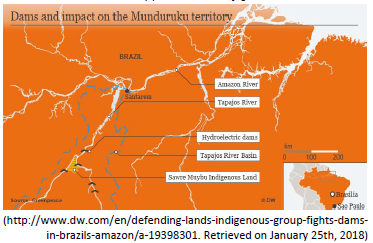
This is the gateway to a land that indigenous inhabitants call Mundurukania, after their tribe, the
Munduruku, which has settled the middle and upper reaches of the Rio Tapajós since ancient times.
The thickly vegetated shores, misty hills and untamed waters – breached at one point by a dolphin –
mark it out as one of the few regions of the planet still to be explored and exploited by industrial
commerce.
The tranquillity is breathtaking, but misleading. These rapids are now on the frontline of one of the
world’s most important struggles for indigenous rights and environmental protection. Long ignored, they
are suddenly seen as a strategically crucial step between the nations with the world’s biggest farms –
Brazil – and the world’s most numerous dining tables – China. Longer term, the changes now being
planned could bring this waterway closer to the industrialised, traffic-filled Yangtze in more ways than
one.
Over the coming years, the Brazilian government – backed by Chinese and European finance and
engineering – wants to turn this river into the world’s biggest grain canal by building 49 major dams on
the Tapajós and its tributaries.
This would make the rapids navigable by barges carrying produce from the deforested
cerrado savanna of Mato Grosso – which produces a third of the world’s soya – up to the
giant container port being planned in the closest city of Santarém and then out to global markets,
particularly in Asia.
The network of dams would also produce 29gW of electricity, increasing Brazil’s current supply by
25%. A consortium headed by Furnas – a subsidiary of the state-run energy utility Electrobras – plans
to sell the power to distant cities and to local mining companies that want to unearth the mineral riches
under the forest.
For the Brazilian government, this mega-scheme to open up the Tapajós basin – which is roughly
the area of France – is a linchpin of national economic development and trade with China. For local
politicians, it is an opportunity to industrialise, expand and enrich the business of nearby cities, which
expect their populations to double in size over the next 10 years.
For opponents, however, the “hydrovia” – as the river transport scheme is known – and related
projects are the biggest threat ever posed to the native inhabitants, traditional riverine communities,
waters and wildlife. By one estimate, 950,000 hectares of forest would be cleared, releasing significant
amounts of carbon dioxide.
(Source:
https://www.theguardian.com/world/2017/oct/05/brazilamazon-tapajos-hydrovia-scheme. Retrieved on
January 11th, 2018)